
US President Donald Trump issues apocalyptic warning on Truth Social as Tuesday night deadline looms for Iran to reopen the Strait of Hormuz amid escalating US-Israeli strikes and global oil crisis.
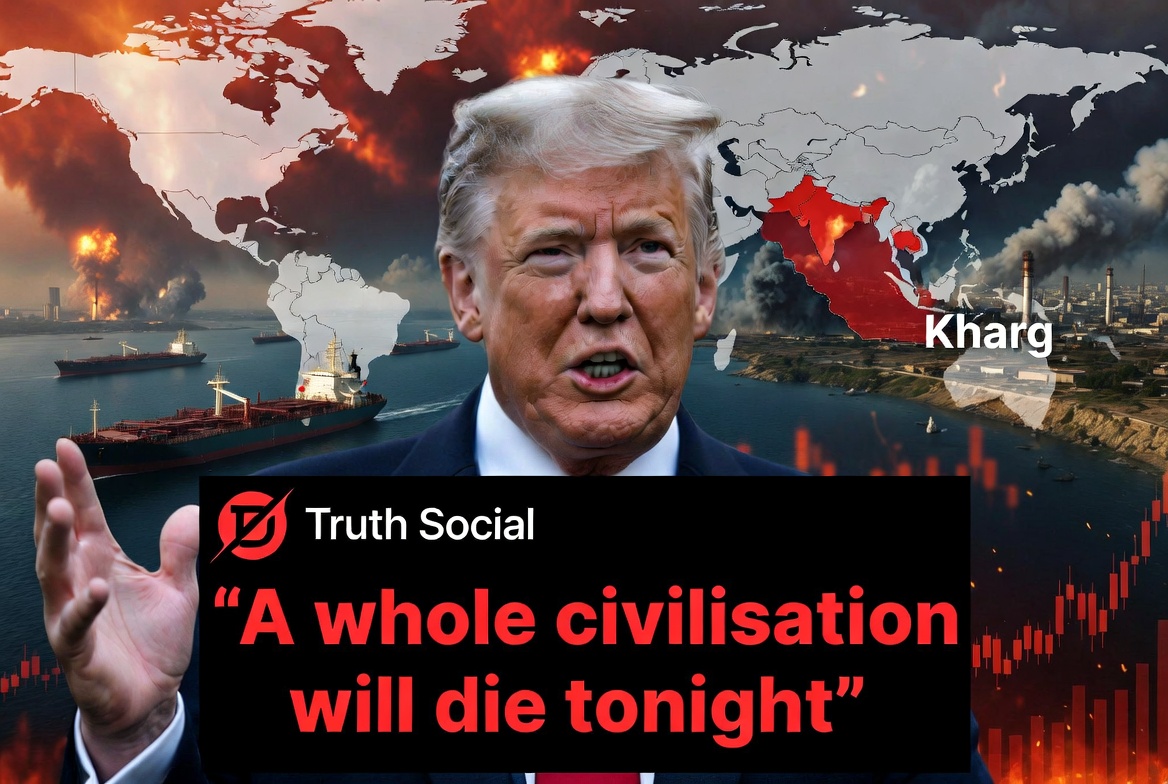
In a dramatic escalation of the ongoing Middle East crisis, US President Donald Trump has warned that “a whole civilisation will die tonight” unless Iran agrees to a deal by his self-imposed deadline. The stark message, posted on Truth Social early Tuesday, April 7, 2026, comes as US and Israeli forces continue targeted strikes across Iran, including on the strategic Kharg Island oil terminal.
Trump’s full post reads: “A whole civilization will die tonight, never to be brought back again. I don’t want that to happen, but it probably will. However, now that we have Complete and Total Regime Change, where different, smarter, and less radicalised minds prevail, maybe something revolutionarily wonderful can happen, WHO KNOWS? We will find out tonight, one of the most important moments in the long and complex history of the World. 47 years of extortion, corruption, and death, will finally end. God Bless the Great People of Iran!”
The deadline — set for 8pm EDT (midnight GMT / 1am BST Wednesday) — demands Iran reopen the Strait of Hormuz, the narrow waterway through which nearly 20% of global oil passes daily. Failure to comply, Trump has repeatedly threatened, will trigger strikes on civilian infrastructure such as power plants and bridges.
Trump’s Warning and the Push for Regime Change
Trump’s latest rhetoric builds on weeks of intensifying pressure since the US-Israel campaign against Iran began on February 28, 2026. He has framed the conflict as the end of nearly five decades of Iranian “extortion” since the 1979 Islamic Revolution, openly calling for “complete and total regime change.”
Vice President JD Vance reinforced the message, stating the US has “fundamentally” achieved its military objectives and possesses further “tools in our toolkit” if Iran refuses to negotiate.
Critics, including US Democratic senators Chuck Schumer and Chris Murphy, condemned the language as reckless, with Murphy accusing the administration of planning to “murder thousands of innocent Iranians” in hopes of sparking internal upheaval.
Latest Military Developments in the Iran Conflict
Overnight and into Tuesday, US forces struck military targets on Kharg Island, Iran’s primary oil export hub, without hitting oil infrastructure itself — a move confirmed by US officials.
Israeli strikes targeted bridges and railway segments in multiple cities including Tehran, Karaj, Tabriz, Kashan, and Qom, which Israel says are used by the Revolutionary Guards. Iranian state media reported casualties, including two killed and three injured in one bridge strike, while train services were disrupted after Israeli warnings to civilians.
Iran has responded with missile barrages toward Israel and claimed a drone and missile attack on a Saudi petrochemical complex in Jubail. The Islamic Revolutionary Guard Corps (IRGC) warned that any further US “red lines” crossed would trigger retaliation “beyond the region,” potentially targeting global oil and gas supplies.
The Strategic Importance of the Strait of Hormuz
The Strait of Hormuz remains the epicentre of the crisis. Its closure or severe disruption has already triggered a global energy shock worse than the 1973, 1979, or 2022 oil crises, according to the International Energy Agency’s Fatih Birol. Developing nations are bearing the brunt through soaring fuel, food, and inflation costs.
Reopening the strait is Trump’s core demand for any ceasefire, though Iran insists on a permanent end to hostilities and guarantees against further Israeli or US attacks.
Iran’s Stance and Last-Ditch Diplomacy
Tehran has shown no sign of immediate capitulation. The IRGC claims “considerable restraint” so far but vows a broader response if civilian targets are hit. Iranian officials say “more hopes are emerging” from back-channel talks, with Pakistan, Egypt, and Turkey reportedly acting as intermediaries.
However, Iran has rejected short-term ceasefire proposals, demanding a comprehensive deal that addresses its security concerns, including the conflicts in Lebanon and Gaza.
Global Ramifications of the Middle East Crisis
The conflict has already killed thousands in Iran, with human rights groups reporting significant civilian casualties. Energy markets remain volatile, and Gulf states are on high alert following Iranian threats to retaliate against neighbouring infrastructure.
As the deadline ticks down, the world watches to see whether Trump’s high-stakes gamble leads to a breakthrough “revolutionarily wonderful” deal — or plunges the region into even deeper chaos.
Live updates will continue as the situation develops. What are your thoughts on this rapidly unfolding Middle East crisis? Stay tuned for the latest on Trump’s Iran ultimatum, the Strait of Hormuz, and the broader US-Israel-Iran war.